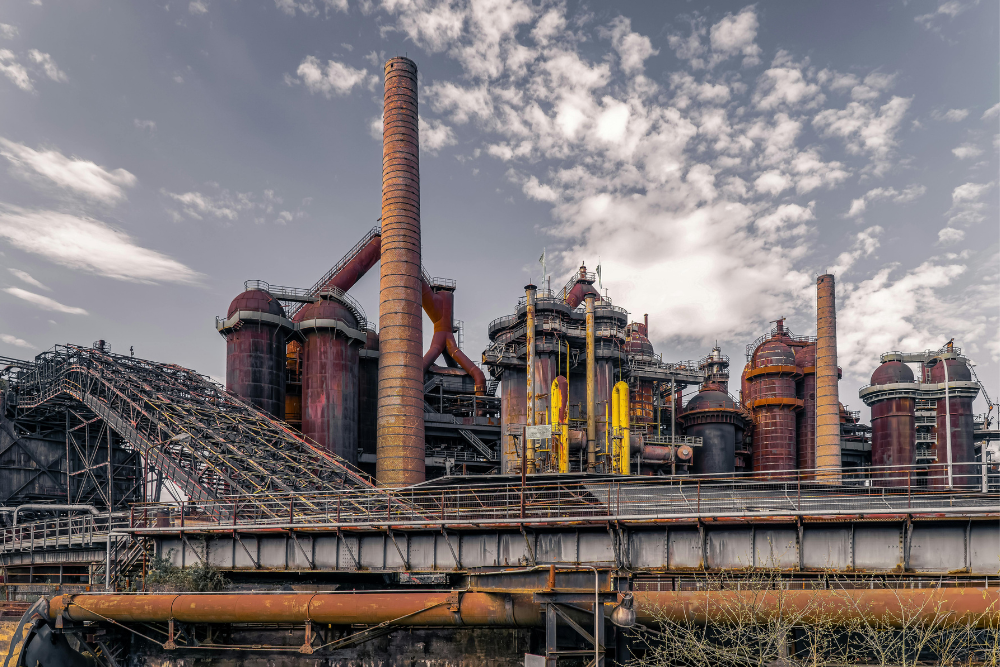
The customer is a large integrated steel manufacturer producing flat-rolled steel for automotive, construction, appliance, and industrial markets. The facility encompasses ironmaking, steelmaking, casting, rolling, finishing, and extensive utility and water systems that support complex production processes.
Total Filtration Services has supported the customer’s filtration needs for more than a decade. As new personnel became involved in the facility’s blast furnace operations, TFS saw an opportunity to reintroduce its capabilities while also demonstrating how its broader network of technical resources could support needs beyond filtration.
Challenge
Total Filtration Services partnered with Cleveland Pump Repair & Services to conduct a Lunch & Learn with personnel involved in operating, maintaining, and managing equipment within the facility’s blast furnace area. The objective was to introduce Cleveland Pump Repair’s capabilities and identify additional opportunities to support the customer’s equipment and reliability needs.
During the discussion, the customer identified a challenge involving legacy pumps that had provided reliable service for years but were now obsolete. Although the facility had confidence in the existing pump configuration, obtaining replacements had become increasingly difficult.
Available replacement options would have required the customer to transition to a different pump design. Doing so could have required significant engineering and structural modifications to accommodate the new equipment, with the project team estimating potential costs in excess of $1 million.
The customer wanted another option. Rather than redesigning the application around different equipment, the facility wanted to maintain a pump configuration that had already demonstrated reliable performance in its operations.
Reverse engineering the existing equipment presented another obstacle. The customer did not want to send the critical pumps off-site for evaluation, and other potential suppliers had not been willing to perform the necessary scanning at the facility.
The TFS Solution
After listening to the customer’s concerns, Total Filtration Services and Cleveland Pump Repair & Services developed an approach centered around the facility’s existing equipment rather than asking the customer to adapt its operations to a different pump design.
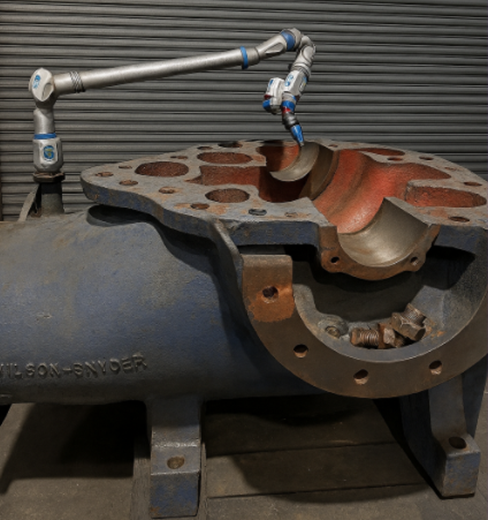
Cleveland Pump Repair identified on-site scanning as the first step. By bringing the scanning capabilities directly to the facility, the team could capture the dimensional information needed to reverse engineer the legacy pump without requiring the customer to ship the equipment elsewhere.
The pump was scanned on-site, and the resulting information was converted into engineering drawings. This allowed Cleveland Pump Repair to develop a replacement based on the customer’s existing configuration while also creating documentation that could support future replacement components and spare-parts planning.
Using the information collected during the scanning and engineering process, Cleveland Pump Repair reverse engineered and manufactured a replacement pump.
Timing became another important consideration. When the original proposed lead time did not align with the customer’s planned outage, Total Filtration Services and Cleveland Pump Repair worked with the facility to develop an expedited schedule that could meet the required outage window.
The resulting solution combined on-site scanning, reverse engineering, engineering documentation, manufacturing, and outage coordination. Ultimately, the replacement pump was manufactured and installed while allowing the customer to maintain the proven configuration it had successfully relied upon for years.
Results
By scanning and reverse engineering the existing pump, Cleveland Pump Repair was able to manufacture and install a replacement based on the proven configuration the facility had relied upon for years, providing an alternative to transitioning to a different pump design.
Reverse engineering may also provide a significant cost advantage for aging or obsolete equipment. For complete pump assemblies, this approach can typically provide 50–60% cost savings compared to purchasing a new replacement pump. For individual pump casings, scanning and reverse engineering can often reduce costs by 30–40% compared to purchasing new OEM casings.
The project also provided value beyond immediate replacement. On-site scanning created engineering documentation for legacy equipment where original drawings and replacement components were not readily available. This information can now support future replacement and spare-part planning, providing a foundation for a more proactive approach to equipment reliability.
The successful collaboration also expanded the customer’s relationship with Total Filtration Services and Cleveland Pump Repair into additional critical applications. Cleveland Pump Repair is now supporting repair work for boiler feed pumps that play an essential role in the facility’s water-steam cycle. These pumps help maintain steam availability for power generation, process heating, vacuum systems, and other utilities that support steelmaking operations.
What began as a filtration relationship has evolved into a broader reliability partnership. By listening to the customers’ needs and bringing together the appropriate technical resources, Total Filtration Services was able to help develop a practical solution for an equipment challenge outside of its traditional filtration scope.
Need help solving a tricky filtration issue?
Whether it’s air, liquid, or process filtration, we’re here to help you find the right solution.
.png)